Student Art Teachers ART SHOW back in 2009


This is a short video piece and taste of a documentary I started to make two years ago and to which I have put on hold to finish. I still plan to put it all together and hope to do so in the coming summer. My idea is to do a documentary on art education and the nature of art the artist and the many ideas and manifestions that art takes.

The sound on this clip is bad in beginning and there are some glitches, yet give it a look and let me know what you think or if you would like to be in my documentary.
Thanks for all who participated in this promo. Stay tuned for final.

This is an interesting and web-wide collective art project that gives me good ideas toward creating lesson plans that include collaboration on a grand scale.

SITO is a website for individual and collaborative artists.Here you will find art portfolios of hundreds of artists around the world. Also, SITO.org creates and hosts a number of Internet-based collaborative art projects, including the award-winning Gridcosm and HyGrid.

SITO is free. Look around. Post your art or opinions. It's all subscription and advertisement-free. To post artwork, you'll need a SITO ID.


http://www.sito.org/synergy/gridcosm/


Gridcosm is a collaborative art project in which artists from around the world contribute images to a compounding series of graphical squares. Each level of Gridcosm is made up ofnine square images arranged into a 3x3 grid. The middle image is a one-third size version of the previous level. Artists add images around that center image until a new 3x3 grid is completed, then that level itself shrinks and becomes the "seed" for the next level. This process creates an ever expanding tunnel of images, the newest level a direct result of the previous level which is a result of the previous level... and so on.


I have been thinking about the Big Idea of Social Norms and how they can and do, in many  people's lives,......influence and dictate how we behave, dress, talk, buy, watch, read, eat, and think.
Below is an artist addressing this issue:

http://www.newdream.org/resources/2011-09-artist-critiques-consumer-culture

Artist Critiques Social Norms and Our Consumer Culture

Award-winning artist Mary Ellen Croteau covers a wide range of themes, from sexuality and warfare to global politics. But a strong current of her work is a critique of our consumer culture.
“I firmly believe in the power of the visual, and my work is my voice: a social critique and a visual challenge to all the cultural detritus we are force-fed every day,” she explains. “My art is about looking at things in a slightly different way, and is intended to undermine the status quo with wit and humor.” 
Based in Chicago, Croteau uses a variety of media, from traditional painting to photography to sculpture and installation. Her project "Mountains" (2008) is a series of photos of trash arranged in the shape of a mountain range. The piles include electronic waste, plastic and metal, cattle dung from feedlots, and nuclear waste.
Recent projects have focused on the use of plastic—plastic bags, plastic water bottles, and even plastic bottle caps.
One of her latest pieces is a large (8-by-7 foot) self-portrait, “Close”, made entirely of nested bottle caps and modeled on artist Chuck Close’s painted portraits. Croteau also created several “endless columns” of these caps, after Constantin Brancussi’s iconic modernist sculpture. 
“Bag World”

In an earlier series, “Bag World” (2004–09), Croteau explored the ubiquity of plastic bags in the environment. Her first project involved making a braided bag rope using plastic bags that she accumulated over a seven-month period in 2004. The piece is titled “A Measure of Consumption: 225 days, 68 meters” and is intended to harken back to an era when all waste was recycled.
"I was trying to think what to do with all those bags that you get every time you go to the store,” explained Croteau. “Even if you bring your own bags, they still try to put the stuff in plastic bags before they put it in the ones you brought. And no matter what they tell you, these bags are not recycled. They are just collected and disposed of.” 
For later pieces in the series, Croteau painted replicas of works by well-known artists such as Van Gogh, O'Keeffe,Monet, and Matisse, but she added her own twist by featuring plastic bags among the beautiful landscapes. When exhibited, the installation could only be accessed by wading through a bag-strewn floor, resulting in a performative interaction. 
Croteau’s installation “Waterfall” is made from more than 700 plastic newspaper bags and plastic water bottles, and offers a commentary on “the plasticization of our world, and the destruction of the source of life itself.” In another series, Croteau crocheted plastic bags into replicas of dead coral reef, part of the Hyperbolic Crocheted Coral Reefproject. Croteau talks more about the "Bag World" series in a video interview (below).


Why Arts Education Is Crucial, and Who's Doing It Best

Art and music are key to student development.

"Art does not solve problems, but makes us aware of their existence," sculptor Magdalena Abakanowicz has said. Arts education, on the other hand, does solve problems. Years of research show that it's closely linked to almost everything that we as a nation say we want for our children and demand from our schools: academic achievement, social and emotional development, civic engagement, and equitable opportunity.
Involvement in the arts is associated with gains in math, reading, cognitive ability, critical thinking, and verbal skill. Arts learning can also improve motivation, concentration, confidence, and teamwork. A 2005report by the Rand Corporation about the visual arts argues that the intrinsic pleasures and stimulation of the art experience do more than sweeten an individual's life -- according to the report, they "can connect people more deeply to the world and open them to new ways of seeing," creating the foundation to forge social bonds and community cohesion. And strong arts programming in schools helps close a gap that has left many a child behind: From Mozart for babies to tutus for toddlers to family trips to the museum, the children of affluent, aspiring parents generally get exposed to the arts whether or not public schools provide them. Low-income children, often, do not. "Arts education enables those children from a financially challenged background to have a more level playing field with children who have had those enrichment experiences,'' says Eric Cooper, president and founder of the National Urban Alliance for Effective Education. Taken from: http://www.edutopia.org/arts-music-curriculum-child-development

The Arts Are Essential

Cornell University's president on why teaching creativity in schools is not a luxury.

"The arts and humanities play a vital role in the educational development of students. They keep and convey our cultural heritage while opening us up to other societies and civilizations around the globe. They help us explore what it means to be human, including both the ethical and aesthetic dimensions. If science and technology help us to answer questions of "what" and "how," the arts and humanities give us ways to confront the intangible, to contemplate the "why," to imagine, to create. If ever there were a time to nurture those skills in our young people, it is now, when our nation's future may depend on our creativity and our ability to understand and appreciate the cultures around the world as much as on our proficiency in reading and math." Taken from: http://www.edutopia.org/arts-education-humanities-creativity


I have been finding all these public art works and artists that take their art to the streets, and it is all good!
I think this is an immediate way to capture attention and leave an impact.
Check out some of the photos, links and videos I have found.
I love the Reinvention of art and all it takes is a few new ideas thrown into the old mix to create something fresh, updated, relevant and provocative.
Projection artist :  Ross Ashton


 The Great Windchime
Free Summer Public Art Project 2006

The Great Windchime was the playful result of a summer-long public art project. Throughout the season, Garden visitors created personal chimes which dangled in The Great Windchime @ AMG. New life was given to old jar lids as visitors painted and decorated them with string and beads. A grand total of 2675 chimes hung on over 1800 feet of paint-dappled rope. Toddlers, parents, grandparents, local artists, and even a few elementary school teachers and their students helped make The Great Windchime @ AMG exceed the current world record of 2500 chimes spanning a distance of 1640 feet. Does that mean this is the world's largest windchime display? While the application to formally beat the world record is still being processed, we'd like to think so!
http://www.annmariegarden.org/annmarie2/windchime

For this project, recycled bottles were used to build PILLARS: Wishes for a Better World. Visitors were encouraged to write a wish, prayer, or sage advice for the world and its inhabitants in hopes of making the world a better place to live.   While famous quotes and song lyrics provided some of the inspiration, many chose to use their own voices to profess their thoughts. Advice from the participants spanned a broad range of topics; from environmental awareness (Recycle, Plant a tree, Save the Rainforests), to the importance of family (Hug your children, Love your daddy, Call your mother!), to wishes for world peace (Make love not war, Promote peace, Don’t fight with each other). Sometimes messages contradicted each other, but were equally important (Work hard, Take time to play, Follow Directions, Don’t be afraid to break the rules!). Small children even offered their advice which, although simple, was profound nonetheless (Share your toys, Listen to your mommy and daddy, Always say thank you). All in all, over 1100 wishes were made.

 As visitors walked through the pillars and read the advice, they had the opportunity to ponder their own wishes for the world, and to find encouragement and inspiration in the messages of their peers. 


http://www.annmariegarden.org/annmarie2/pillars


http://weburbanist.com/2010/03/18/big-screens-big-fun-2-simply-silly-public-art-projects/?ref=search


"Rather than waiting for people to seek out his art in museums or galleries, artist JR brings it to the streets, posting arresting black-and-white portraits of locals around the world on the walls of their neighborhoods. His goal is to give voice and representation to communities that otherwise might be obscured, like women living in Brazilian or Kenyan slums. With his latest global art initiative, theInsideOut Project, JR is spreading his mission on a scale that was previously unimaginable, by crowdsourcing personal photos and the labor of posting them."

Taken from:

http://www.good.is/post/crowdsourced-public-art-project-captures-community-spirit-around-the-world/


Inspirational Public Art:


http://www.dialogueproject.net/index.shtml

Denver Office of Cultural Affairs Presents 1.26, A sculpture by Janet Ec...

Listen to this artist speak on TED.com : Janet Echelman on "Taking imagination seriously"


"I got a call from a friend in Phoenix. An attorney in the office who'd never been interested in art, never visited the local art museum, dragged everyone she could from the building and got them outside to lie down underneath the sculpture. There they were in their business suits, laying in the grass, noticing the changing patterns of wind beside people they didn't know, sharing the rediscovery of wonder." (Janet Echelman)

I first learned about TED TV when my art instructor at the University of Missouri sat us down one day, within our drawing class, and introduced us to a few talks on TED. Elizabeth Gilbert was the first one that gave me a profound "AHA" moment when she spoke of the 'genius' that we all have. I recognized myself and the rest of my classmates in her thoughtful insights and was comforted and inspired by her fresh perspective on creativity.
The second "AHA", was listening to Janet Echelman on Taking Imagination Seriously. It struck me, as I saw her amazing net sculptures undulated in the wind, that my favorite art is the art that is accessible and visible to the general public. It catches people off guard when they notice it while in their rush to cross town or in their short lunch break, and it can have a deep and lasting impact on them within just a few seconds of noticing a new image, form or performance. It's this kind of art that derails the left brain train so that the right brain air balloon can lift them above the caos to a heightened view of the beauty around them. I believe inventive, thoughts manifested give form to formless ideas living in our imagination. It is my hope, as an art educator, help open up the imaginations of my future students and my potential school and community to appreciate the importance of nurturing both our intellect as well as our genius so that when the spirit of pure creative potential comes flying by we will grab onto it's tail and be confident that it will lead us to greater perspectives and new discoveries we all can benefit from. Conceptual art that sits in galleries or museums is interesting yet I dont see it's purpose or contribution if it's important ideas are lost in translation or kept a secret to only the privileged few that understand it's history and codes.
Maria Scuderi Oct. 10/2011
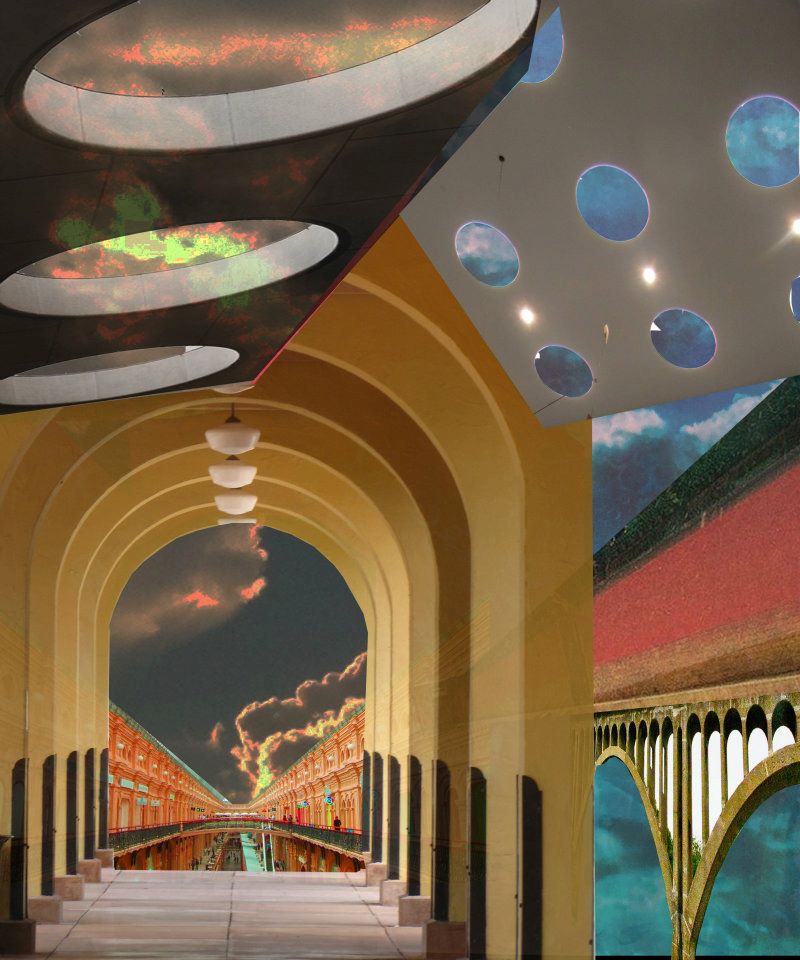
some new art by Me:


Video ART by: Bill Viola