Steal Like an Artist

Number 9 and 10 from:

Austin Kleon's 10 Things Every Creator Should Remember But We Often Forget

9:
Draw the art you want to see, start the business you want to run, play the music you want to hear, write the books you want to read, build the products you want to use — do the work you want to see done.

# 10: 
There’s an economic theory out there that if you take the incomes of your five closest friends and average them, the resulting number will be pretty close to your own income.  I think the same thing is true of idea incomes. You’re only going to be as good as the stuff you surround yourself with.

Taken from (steallikeanartist.com)

These are the kind of reminders I need in a frame.

Sir Ken Robinson makes the case for a radical shift

I just cant stop myself, TED TV is my link to all that is just and pure and evolutionary and I simply must share the wealth and the good vibrations of hope I feel after watching many of these inspired speakers. So here is another yet never the last......

"Students with restless minds and bodies -- far from being cultivated for their energy and curiosity -- are ignored or even stigmatized, with terrible consequences. "We are educating people out of their creativity," Robinson says. It's a message with deep resonance"
(ted.com)


http://www.ted.com/talks/sir_ken_robinson_bring_on_the_revolution.html

(I apologize......but I cannot seem to get this link to work. You will have to copy and paste it
into your browser.)

Charlie Todd: The shared experience of absurdity

Just had to share this cause this is the kind of art I would love to do every day!!


Charlie Todd: The shared experience of absurdity

Post # 7 Love letter from a lonely Sun Tunnel


Dear Maria,
I heard some Tori Amos from a distant passing car radio and was reminded of you and our last encounter. You turned me on to Tori the day you laid in my lap, watching the sun set with your ipod echoing through my hollowness singing... "And Im so sad, like a good book, I cant put this day back, a sort of fairytale with you." I will never forget the connection we made and how good it felt to be fully appreciated. The time you took to visit with me and be present with me alone in the mid daylight till long after sunset is one I will never forget. Being out in the world is liberating. I have all the space I need to relax and be peaceful with the environment around me, yet I am alone and others like me are few and in distant areas. My relatives, as you know, are stuck inside and mostly behind glass or crowded beside others. But you came to me with great joy and wonderment. You took the time to get to know me, to experience the power, beauty and grace within me and without me. I miss that, and long to make that connection again. Dont get me wrong, I do have visitors and new admires discover me, along the way, yet  some view me as three, strange, displaced objects and dont even bother to come sit on top or within me. Photos might be taken yet most are out of novel curiosity rather then valued documentation of a glorious day spent viewing an amazing slice of life from within my circular frame that was intentionally placed on this specific spot for all to engage with and enjoy. Tori's song reminded me of you and how even though our time together was like a fairytale, you made me feel real, and worthy of being more than a hollow shell of concrete. Our interaction helped me to see my meaningful contribution as a part of the the bigger picture. Im sending a few more photos for you to remember me and. "like a good book", share me with all your friends.
Sincerely,
Sun Tunnels...
By Nancy Holt.....(located in the Great Basin Desert, outside the ghost town of Lucin Utah)


Post # 6.....Peter Pan, Play and Pleasant Surprises!

Whenever I think of the idea of Play, I think of Perter Pan flying back to never never land and creating his imaginative world with the lost boys who wont grow up. When I was in 6th grade I was in the play and I will never forget the lyrics to the song..."I wont grow up, I dont wanna go to school, just to learn to be a parrot and recite a silly rule. If growing up means it would be, beneath my dignity to climb a tree, I'll never grow up never grow up, no way, no sir, Not ME!"

While looking at the photos I took of our paper structures I could not help myself and continue to play even more. Tinker Bell must have snuck in and sprinkled fairy dust on me because I started playing around 8pm and when I finished It was 10:30 and I was shocked how much time had passed without my realizing it. Most artists that loose themselves in the process of art making call this being 'in the zone', 'getting in the groove', or entering the 'flow'. I guess it is the same as flying off to never never land for a visit.
Below is the succession of photos from a wide angle shot to abstracted close ups. I have included some original shots paired next to their digitally enhanced, cropped and/or rotated twin.
Please scroll down to read the answers to the Questions posted in relation to our "Play" time and these photos.
(CLICK ON A PHOTO TO ENLARGE AND VIEW IN A SLIDE SHOW)


{You have created a photograph of a section of your paper structure...
How are the 2 artifacts ( structure and photo) different? similar?}

I am sorry I could not and can not choose just one section of our paper structure. This playful idea and experiment has expanded beyond the stated perimeters and evolved into a new experiment and entity of it's own. While editing photos that I took of the paper structure, I was overwhelmed with all the different combinations, configurations, color saturations and abstractions that presented themselves to me as unique sections that asked to be represented and admired for their contribution.

{How are the 2 artifacts ( structure and photo) different? similar?}

The structure was several parts constructed separately that came together in collaboration to form a whole. The photo, or in my case, photos were intentional, manipulated images of the form with specific attention to it's representations of light, shadow and color. 
The structure was created out of game like rules, with a set goal and set time limit. Quick critical thinking  along side improvisation had to be used to accomplish the given task.
The process of capturing a photo was less about problem solving and imagination and more about observation and framing. 
Similarly the element of surprise, happy accidents and unexpected outcomes applied to both the creation of the structure and the viewing of the photographic images. Having time constrains or not, both products of exploration and creative play had their own agenda and therefore created themselves with the aid of our hands or eyes to be the conduits to translate and give form to inspired thoughts.

{How does your vision translate from 3D to 2D?}

The 3D form is tangible and flexible, it can be reconfigured, deconstructed and then reconstructed again into a new form. 
This too is true of the 2D image, yet it is only a representation and a single angel or slice of the whole.

{Does this process change the way you SEE the structure?}

Yes, the structure becomes a modle, or a prop, something that can be used for creating art.
Therefore the 2D photographic image becomes an art piece by selecting what view, angle and abstracted area of the 3D form to highlight and present.

{Synthesis of PLAY experience (Symphony) Why do artists play?}

Artist play to liberate themselves from expected common, constraining movement, speech, behavior and thinking processes. Playfulness is part of improvisation and improvisation is part of exploration and exploration is part of discovery and discovery is part of trusting our senesces to lead us into uncharted territory to experience the unexpected. The unexpected can be an intangible, inspired spark or a tangible material creation. Just as a symphony has many separate instruments with different arranged notes so does art making. The artis needs to play so that they can try different instruments and listen to different notes before they can choose the right ones to arrange into one harmonic piece.

{How has playing with paper reinforced the importance of play? What did you learn about play in this class?}

Playing with paper reminded me of how a child can be content and stay interested in a simple material or object such as a box. It reminded me of those days when I did not have anything but a sheet to create a fort or paper bags to make moon boots. I can see how taking time to play builds creative muscle. If I let my imagination have the stage, without putting any restrictions on it, then my imagination becomes the performer and the material or medium becomes the interactive audience or participant which is needed in the symphonic exchange. The fule and the oxygen, the teacher and the student. It must be an open, fluid, symbiotic relationship for real meaning making to take place.

{I attached a presentation by Olivia Gude about the PostModern Principle of PLAYING. View and respond on your blog.}

Olivia Gude mentions how..."Every man and every woman deserves the personal conviction that they themselves can, by right, have resource at will to this language which is not in any way supernatural, and is the vehicle, for each and every one of us, of revelation."

"Awe, surrender, gaming, and collaboration" These are important for allowing the 'Principles of Playing' to engage in any combinations of possibilities of manifestation.

This weekend I saw an amazing documentary on Marina Abromovic, an original performance artist. the movie was called, Marina Abramocic: The Artist is Present.
She is quoted as saying:"Through performance, I found the possibility of establishing a dialogue with the audience through an exchange of energy, which tended to transform the energy itself. I could not produce a single work without the presence of the audience, because the audience gave me the energy to be able, through a specific action, to assimilate it and return it, to create a genuine field of energy."

She also says "The Artist must be a warrior" To me I think that translates as...warriors are fearless, yet prepared to confront what they encounter on their journeys. They must be sensitive, and alert, ready to accept that which may present itself to them.
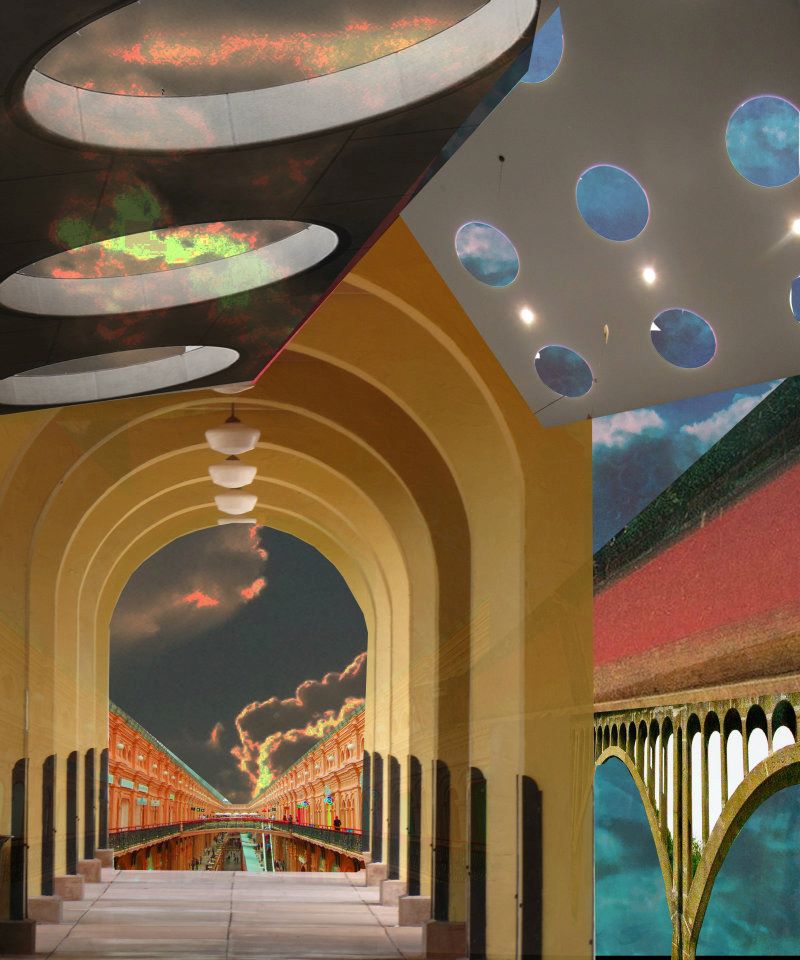
It will take big, creative imagination for us to evolve to the next step. Imagination is not fed by fear, but by beauty… greater than our knowledge of a thing, is a sense of wonder. And, out of that wonder, curiosity, and from that curiosity, a seed of creation. – Susan Osborn

Post #5...Our Time Has Come, and the Pink sea has been parted

I like the way the introduction of Pinks book opens with a biblical sounding declaration, "...artists, inventors, designers, storytellers....big picture thinkers...", and 'Big Idea' meaning makers, "...will now reap society's richest rewards and share its greatest joys." and so it came to pass as right-brains asserted themselves and rose up to follow their chosen democratic leader, Daniel, as he parted the logical, linear seas. For it was Daniel that the Goddess of creativity, Sarasvati, beckoned to create a great stage for all the artists to perform upon. On this world stage many forms of imagination and creation would take place. The R-Directed players would interact, improvise and construct as the L-Directed doers would manage and maintain the business behind the stage.

After reading all the chapters and watching Daniel Pink speak, I felt a calm, warm feeling come over me, even though I know it is getting late, I should be in bed and done writing already. The feeling has to do with acknowledgment and a sense of validation. All three authors mentioned things that I feel I have always known and or that I have always had an inclination toward. I do feel like my time has come yet as a R-Directed student, I have had to enlist the troops and all the reserves from my L-Directed mind to get me where I wanted to be...'Here'..now. Like Daniel Pink says in A Whole New Mind, "In the end, yin always needs yang." (25). Pink speaks how left brain thinkers have been in the drivers seat and now it is right brain thinkers turn behind the wheel. I can understand this as far as business and economics go yet I don’t agree that right brain thinkers were passengers. I guess I never felt like a passenger and I have always been behind the wheel with my foot on the gas heading toward unexplored territories with a wild anticipation of what lies beyond the next turn. I think that Pink opened his right brain window, wide, allowing the light to illuminate that which he calls the "six senses". This colorful flood of sensation was like a divine intervention. He experienced the power of the Creative Goddess and knew he had to spread the word. (I love when our team wins one. It's like "red rover, red rover send Daniel right over").

And then there is Freedman and Eisner both preaching the word of a healthy, balanced, culturally attuned, democratic, explicit and implicit curriculum. I say "Amen" to that! These were my favorite chapters so far, since I can directly relate them to my student teaching. I must first start with an apology to my anti-art teacher. I feel that I made some misinformed judgments. I am now seeing how the Left Brain directors have created conditions, restrictions and ridged policies, which hinder, and prevent my host teacher from exercising her own playfulness and using more of an "expressive outcome" when implementing her curriculum instead of the outdated "operationalized objectives" curriculum. Eisner,(161). "Expressive outcomes are the outcomes that students realize in the course of a curriculum activity, whether or not they are the particular outcomes sought." Eisner, (161). Freedman picks up on this in her, "Five Conditions of the Curriculum Process" and she states in condition number three that, "curriculum is a creative production.....", "Acts of teaching and learning are part of the process of curriculum. it is a translation of knowledge into information that is selected, organized, and interpreted by the curriculum developer which is then taught to students through another interpretation, which will be reinterpreted by the students as they create their own knowledge." (110).  My host teacher wants to be more playful and allow for deeper learning, yet she/he has been oppressed by prescribed, measured objectives and standards that she/he claims use to work, yet lately she/he has noticed a change in attitude and cooperation from the students. For me this has been so much more then a leaning experience in how to run a class and deliver a lesson. I am seeing how it takes just as much energy and time trying to control, and manage a classroom to stay obedient while following technical steps and similar objectives, without question; compared to the time and energy it takes to allow for conversation, exploration, imagination and group participation. There is a big difference between just following rules and expectations so that there is no room for mistakes or questionable content and feeling socially responsible as an educator who aids students in making cognitive connections with relevant, visual culture while at the same time allowing for conceptual conflict. I think Eisner's idea of a curriculum that is explicit, implicit and null, is more in tune with a Yin/Yang balanced curriculum. "Classroom ambiance, school norms, modes of assessment, and the like teach not explicitly, but implicitly. Thus, we not only have an explicit curriculum in schools, but also and implicit curriculum, and it is the implicit curriculum that endures while sections of the explicit curriculum change over time;..." (158).
I can say that I have witnessed the meaning of Eisner's quote, "When birds have led their life in a cage, it is not difficult to understand that when the door is opened, they might not have a desire to leave." (153)
The 6th and 7th grade students I have been working with have not been given choices, not allowed to question or investigate and not allowed to define their own goals. They have not had any practice in exercising their imagination or sense of play. Therefore when I revealed my Big Idea lesson and gave them opportunities to do all of those, above, things, they were confused. They liked the presentation and after several examples, videos, tutorials with constant questions and answers they still did not know where to start or how to create their very own ideas without a step by step one-size-fits-all hand out. Along with helping my baby birds learn to fly; I am also realizing what my purpose is and how to utilize all my years of being a 'R-directed thinker'. My cumulative incarnations of actress punk-rock beat poet drummer improvisational comic have all led me to my final holistic expression of the artist that uses teaching as her medium to construct a multifaceted ever evolving class of brave new birds confident in their ability to fly. 
(Thank you Sarasvati for your Divine inspiration!)


Sarasvati is the Hindu Goddess of all arts: music, painting, sculpture, dance, and writing. She is credited with presenting the gift of writing to mankind so that her songs could be written down and preserved. Sarasvati is often depicted on the back of a swan or peacock, and with four arms, with which she plays the lute or drum and bestows jeweled blessings. She is the Goddess of eloquence, and words pour from her like a sweetly flowing river. One myth of this Goddess is that She is a jealous rival of the Goddess of wealth, Lakshmi, and that pursuing wealth alone will assure that Sarasvati's gifts will desert you.


Post #4....the Art of meaning making

First I will apologize for this post since it will be short. I am running on fumes and may crash and burn at any moment.
I never knew how exhausting a small group of six graders could be, especially when their are six, out of 24, that need constant redirection, tailored instruction and personal attention. However it is my belief that if the teacher would have set the room up differently and would allow for group learning, these six would benefit from what John Dewey titled, "The Educational Situation". In his article he explores how the construction of meaning was not only. "Activated by the prior experience the child brought to the situation; it was also the result of the child's interactions with the social and material conditions in which he or she worked." The art room, that I am teaching in, is void of any group democratic input, or personalization of space. There are no representations of visual culture or any kind of modern, contemporary art to view. It is more like a workshop where students come to work individually with little to no interaction. If the students had some choices, or even their art displayed in the room, they may feel more comfortable to explore and take risks.
Eisner and Freedman both speak of learning within a community and building a space and a curriculum that incorporates visual culture with an understanding and engagement of cross cultural, interdisciplinary and extra-disciplinary contexts. While Freedman says that this will ..."allow information from inside and outside of school to be connected to school subjects", It will also allow the students to be connected to one another and to the environment they create together. The six graders I speak of have no reference points, no back ground, expect for the correlation's between social studies and art from different countries on posters, they have no visual text to read that relates to them or their daily life. "Although the purposes of public school art education have socioculutral roots, children have been represented in curriculum as though they are without attributes of culture, Such a conception of individualism supports the idea of a fictional free self -expression in school (an inherently social institution) through the teaching of art (a product of cultural communities). The focus on this conception of "natural" individualism in curriculum has resulted in the neglect of both cultural similarities and differences." Freedman, (75).

Post #3 doing some Theorizing

"Theorizing art in education is difficult because it involves two often conflicting forms of practice - education, which seeks predicted learning outcomes; and art, which seeks the unpredictable."
(The anti-art teacher likes predicted learning since it is easier to grade)

"...art education seems under-theorized in the sense that curriculum is often a succesion of isolated, skill-based activities rather than being based on rich conceptual frameworks."
(The anti-art teacher likes isolated, skill-based crafts, because it is neat and tidy busy work that is easy to grade)

"Visual culture creates, as well as reflects, personal and social freedoms, and as result, consideration of its character and impact is critical to a democratic education."
(There is no choice, voice and for sure no democracy in the anti-art teachers art room!)

While working in direct contact with middle school students and seeing how they respond to art activities first hand, I feel I am in the perfect situation to start connecting the dots and making sense of what our chosen authors are theorizing about. While working with the anti-art teacher I have witnessed her/his art lessons to be "monological". According to Kerry Freedman's theory, this term refers to mediated quasi-interaction, usually from books, TV, or the web, yet the anti art teacher's lessons are one-way transmissions of information that do not demand a reflective response. As a teacher in training, this is a problem since a school, a classroom and, most definitely, an art room are some of the few structured, dialogical environments for students to help decode and make meaning out of their monological experiences. As I have been thinking of ways to create a dialogical relationship with the students I have been thinking how each student has different backgrounds, influences, cultures and possibly different 'mediums' for learning. Suddenly the students become pre-teen walking, talking works of art. And my job is to try to 'interpret' and understand them within their historical and present day context. I began to think of ways of teaching and ways of how to better understand their pre-teen minds and I thought it was interesting how I could substitute the word, "pre-teen student" in place of the word "Art" for most of Terry Barrett's, Principles for Interpreting Art. 
Try it yourself....

"All art is in part about the world in which it emerged."
"All art is part of other art."
"To interpret a work of Art is to respond to it."
"Artworks attract multiple interpretations and it is not the goal of interpretation to arrive at single, grand, unified, composite interpretations." 

Before I can teach pre-teens how to interprete art and visual culture I need to first be able to 'read' my pre-teens. They too have hidden codes that are, "open to some and closed to others because of culture, age, gender and familiarity with current and past events..." (Barrett: Interpreting Visual Culture)

Even though the art teachers have teamed up with Social Studies to plan their lessons for a  integrated curriculum, it seems to me they have missed the point. The lessons are the same  each year and are based on the traditional arts and crafts made within a chosen country. There is no questioning, no room for greater interpretation or comparison. Freedman would not approve, since number 5 of, "foundations of teaching visual culture" is: Cultural Response, not cultural copy crafts. Upon inquiry into wether the anti-art teachers had tried lessons with the Big Idea concept, Both teachers said, "No, the students cant grasp those kind of ideas."
The anti-art teachers are not to blame, they simply have not been reformed yet. The new Art ministry does not go door to door with the "Art for the 21st century bible". And no one has turned them on to the transmedial experience. And Semali, has not told them that... "the authority of teachers and the certainty of what was learned in the classroom and regarded as stable have begun to slip and slide. With the introduction of computers, the Internet, and a plethora of ways to access academic resources that come with these technologies, knowledge is being democratized.
The existence of multimedia calls for multiple forms of literacy, forms that can represent the world of ideas, emotions, and events with multiple symbols."
(from the article, Tansmediation as a Metaphor...)


I guess I will find out for myself when I barrow from Dewey, Postmodernists and transmediation to construct my own art curriculum with the aesthetic of conceptual/performance Art.
After all, "Great works of art are often considered great because they go beyond expectations." Freedman, told me so.


"A culture populated by a people whose imagination is impoverished has a static future. In such a culture there will be little change because there will be little sense of possibility."

(Taken from: The Arts and the Creation of Mind)
By: Elliot W. Eisner

What is this word "Possibility" and why does it sound familiar to me???

Post #2 "Yes and....I have a confession"

Confession
After two very challenging weeks teaching along side the Anti-Art teacher from Burn-Out Town, along with other life challenges I felt my "Juicy" creative fule was drying up fast and soon I would crumble into a fine dust.  Just two hours ago I seriously contemplated 8740 Suicide. I was ready to just give up and end it so I could slip into a peaceful mindlessness cushioned with bad sit-coms and big pillows. But suddenly Eisner's book fell on the floor and revealed chapter 3. I decided to give it one more glance and there on the page was my salvation!
The quote,
"The surest road to hell in a classroom is to stick to the lesson plan, no matter what" (Eisner)
became illuminated and I heard the choir of dead artists singing, "You're not alone, stay, stay and save them from which they know no better." "We will show you the way, stay!"
So here I am. Eisner has ushered me back and is showing me, in the first few pages of chapter 3, all the reasons why I am witnessing, first hand, the 'killing' of young imaginations.
He is reaffirming for me that my ideas and beliefs are sound and true and that the ill feeling I have in my stomach is from having to be a silent bystander while anti-art torture takes place inside the sacred temple of imagination.
When reading the quote above I knew it was a sign for me to keep 8740 alive and use its enlightened teachings as a protective shield and sword to ward off anti-art ghosts from the dark ages.
The anti-art teacher has been sticking to a lesson that was implemented back in November and is forcing students to finish a very tedious, ill planned, mosaic made by cutting small bits of colors from magazines and pasting them onto intricate drawn boarders around a centrally drawn animal. In the two weeks I have been there over half of the total students have fallen into hell and are becoming defiant, snarling anti-art demons. Most pretent like they are working or do the bare minimum. Some have chosen not to do any more work since it has lost all appeal and instead has become a punishment.
Offense number one:
The anti-art teacher merely transmits information with little or no instruction or examples and instructs students to copy a castel tower "EXACTLY" how it looks on the handout. Eisner explains how each student will mediate and modify what is being conveyed and in this case several students were dropping like flies as the blood left their sweet little faces and they sank down saying, "I hate this, I dont like art, I cant draw like that, I cant make it look exactly like that." The point was not to mimic but to notice and to translate yet the anti-art teacher did not explain the point and did not show tricks or even give tips.
The "Situation" set up by the anti-art teacher did not promote a creative appetite to learn. The students were not learning through qualitative related experiences, even though that was most likely the purpose of the lesson; instead, they were learning how to follow directions and how to dislike art since it was a tedious chore to keep them busy and quiet.
In Creating Meaning Through Art by Simpson, and others, they state, "Factors that got my students involved included my understanding of them, the classroom environment I created , and the teaching strategies that I used." Viktor Lowenfeld wrote that, "Motivation is meaningful if it is adequate to the developmental level and is keyed to specific interests of the child"
Offense number two:
Not participating in improvisation and saying, "Yes and..." as explored in Imagination First. The anti-art teacher teaches art like it is a serious math class and shehe uses what Eisner calls, canned scripts. Shehe expects the correct response to hisher prefabricated, formulaic instruction. "Externally defined routines might be appropriate for workers on an assembly line...; they are not appropriate for teachers."
I know it sounds bad, and I was being a bit mello dramatic, but the anti-art teacher has good intentions after all. Shehe got lost in the woods along the way and has developed, "secondary ignorance"; that is, by not knowing that you dont know." Which is part of how Eisner has helped me to understand how the anti-art teacher had to face, "the arduous task of trying to figure out on 'hisher' own how things went and what might be done better."
(Stay tuned......more to come)
Lincoln Center Institute
Capacities for
Imaginative Learning
LCI has created the Capacities for Imaginative
Learning as a framework for student learning,
applicable to the Common Core Standards across
the curriculum.
The Capacities operate as both
strategies for, and outcomes of, study according 
to LCI’s practice.

Contact Us: 212.875.5535
Email: lci@lincolncenter.org
Visit: www.lcinstitute.org

The Capacities for Imaginative Learning are:

Noticing Deeply to identify and articulate layers of detail in a work of art or other
object of study through continuous interaction with it over time.
Embodying to experience a work of art or other object of study through your senses,
as well as emotionally, and also to physically represent that experience.

Questioning to ask questions throughout your explorations that further your own
learning; to ask the question, “What if?”

Making Connections to connect what you notice and the patterns you see to your
prior knowledge and experiences, to others’ knowledge and experiences, and to text
and multimedia resources.

Identifying Patterns to find relationships among the details that you notice, group
them, and recognize patterns.

Exhibiting Empathy to respect the diverse perspectives of others in the community;
to understand the experiences of others emotionally, as well as intellectually.

Living with Ambiguity to understand that issues have more than one interpretation,
that not all problems have immediate or clear-cut solutions, and to be patient while a
resolution becomes clear.

Creating Meaning to create your own interpretations based on the previous
capacities, see these in the light of others in the community, create a synthesis, and
express it in your own voice.

Taking Action to try out new ideas, behaviors or situations in ways that are neither
too easy nor too dangerous or difficult, based on the synthesis of what you have
learned in your explorations.

Reflecting/Assessing to look back on your learning, continually assess what you
have learned, assess/identify what challenges remain, and assess/identify what further
learning needs to happen. This occurs not only at the end of a learning experience,
but is part of what happens throughout that experience. It is also not the end of your
learning; it is part of beginning to learn something else.

Ping Pong Post #1

“Work in the arts is not only a way of creating performances and products; it is a way of creating our lives by expanding our consciousness, shaping our dispositions, satisfying our quest for meaning, establishing contact with others, and sharing a culture.”
(Eisner)
This makes me think of  “the art of fine living” These are the principals of how to live an artful life. Ping over to Freedman, and it refers to her opening quote about, “When students develop a deeper understanding of their visual experiences, they can look critically at surface appearances and begin to reflect on the importance of the visual arts in shaping culture, society, and even individual identity.”
Ping back to Eisner, and his Principle Four, under guiding practice, is art education should help students become aware of their own individuality.
So true so true, after all, artists are individuals not conveyer belts. This is important and I am seeing first hand how art lessons with prescribed outcomes are mechanical, leave no room for expression and teach nothing but how to follow directions and mimic the same basic form. This turns into a monological type of communication which is one sided and as Freeman states, “does not demand a reflective response.”

I like the way Eisner distilled down the process of how we recognize, make note of, filter and finally share those fleeting ideas we grab, nurture and allow to grow into a separate entity. Through what Eisner says is, “the role of the arts in refining the senses and enlarging the imagination”, he gives us terms to use for the process of realizing, harvesting and then manifesting that which we call art. Through inscribing, editing and communicating, representation takes place. I find it interesting since I have always thought of the creative act as being a spiritual act, one in which the artist is in communion with the collective unconscious. If open to receive the gift of an elusive, or as Eisner says, “evanescent” idea an artist can give birth to art which then becomes a conduit for new interactions and communication. And this reminds me of a wonderful TED TV talk by Elisabeth Gilbert when she speaks of nurturing creativity and the origin of the word Genius. (MUST WATCH link below)


http://www.ted.com/talks/elizabeth_gilbert_on_genius.html

Both Eisner and Freeman speak of visual signs and visual culture. They both mention how important it is for our art curriculums to teach our students artistic intelligence. This will empower them to construct their own visual culture and enter into a multicultural dialogue. And all of this goes hand in hand with Creating Multicultural Learning Communities by Sonia Nieto.
Just as art education is becoming part of the interwoven fabric of a well rounded curriculum so is the realization that all of our curriculums need to be interrelated and in a democratic relationship to help foster the types of inspired imagination that it takes for a culture to progress and evolve. In Nieto’s book, she states that we should, “build on what your students know”. Build on their strengths. “Acknowledging that students have significant experiences, insights and talents to bring to their learning and finding ways to use them in the classroom.”

Bumper Stickter

"A culture populated by a people whose imagination is impoverished has a static future. In such a culture there will be little change because there will be little sense of possibility."

(Taken from: The Arts and the Creation of Mind)
By: Elliot W. Eisner

Still reading, slow going, but Wow! lots of juicy meat to consume!